Every startup founder and small-business owner eventually hits the same wall: there’s work that needs to get done —
a logo, a website, a product description, a video edit — and no one on the team has the skill, time, or bandwidth to do it well. That’s where freelancers come in.
But “just hire a freelancer” is easier said than done. The freelance market is enormous, prices range wildly, and quality varies even more.
Get it right, and you’ll find a reliable specialist who becomes a long-term asset to your business. Get it wrong, and you’ll lose money, miss deadlines, and end up redoing the work anyway.
This guide walks through the entire process — from figuring out what kind of freelancer you actually need, to finding one, evaluating them properly, understanding how pricing works, and applying all of it to a real example: hiring a graphic or logo designer.
1. Why Choosing the Right Freelancer Matters
Hiring the wrong freelancer rarely fails loudly. It fails quietly — a missed deadline here, a design that misses the brief there, a writer who doesn’t quite understand your audience. Individually, these problems seem small. Together, they cost real money and real time.
A few common consequences of a poor hire:
- Wasted budget. You pay once for the work, then pay again (in time or money) to fix or redo it.
- Delays. A missed hand-off pushes back everything downstream — your launch, your campaign, your client deadline.
- Inconsistent quality. A logo that doesn’t match your brand, copy that doesn’t sound like you, a website that looks unfinished.
- Frustration and lost trust. Founders who’ve had one bad freelance experience often become reluctant to outsource again, even when outsourcing is exactly what their business needs.
The good news: almost all of this is avoidable with a bit of process. Choosing the right freelancer isn’t about luck — it’s about knowing what to look for and where to look.
The same logic that applies to your own website’s first impression applies to a freelancer’s work: what your customer sees first shapes everything after it. A weak logo, a confusing site, or clumsy copy sends the same signal a poorly designed website does — and visitors (or clients) act on that signal instantly, often without telling you why.
2. What Kind of Freelancer Do You Need?
Before you start searching, get specific about the type of specialist your project actually requires. “I need someone for my brand” is too vague — specialists are trained in narrow lanes, and matching the right lane to your task saves time on both sides.
Some of the most commonly hired freelance specialists for startups and small businesses include:
- Graphic designers — for marketing visuals, social media graphics, packaging, and print materials.
- Logo designers — for brand identity work, sometimes overlapping with graphic design, sometimes a distinct specialty.
- Editors — for polishing existing writing, whether it’s a website, a book manuscript, or business documents.
- Writers — for blog content, website copy, product descriptions, or email sequences.
- Web designers and developers — for building or redesigning your website, from simple landing pages to full e-commerce stores.
- Video editors — for promotional videos, social content, tutorials, or ad creative.
- Social media professionals — for content planning, community management, or paid campaign execution.
Some freelancers specialize narrowly (only logos, only long-form editing); others offer broader creative services. Neither is automatically better — it depends on your project’s complexity and how much hand-holding you need.
3. Where Can You Find Freelancers?
There are several legitimate paths to finding freelance talent, and most businesses end up using more than one over time:
- Referrals — asking other founders or your network for recommendations.
- Professional networks — LinkedIn, industry Slack or Discord communities, local business groups.
- Specialized job boards — platforms built around specific skills (writing, design, development).
- Freelance marketplaces — platforms that aggregate thousands of independent professionals in one searchable place.
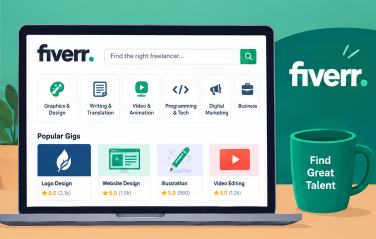
For most first-time hirers, freelance marketplaces are the easiest starting point, simply because they put comparison, reviews, and pricing all in one place. Fiverr is one of the most widely used platforms for this exact reason — it’s built specifically around service-based freelance work, which makes it a practical fit for the kinds of projects covered in this guide (design, writing, editing, video, and more).
Here’s how the process typically works on a marketplace like Fiverr:
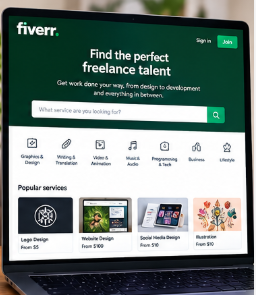
- Search by service. Instead of posting a job and waiting for applicants, you search directly for the service you need (e.g., “logo design” or “proofreading”) and get a list of specialists already offering that exact service.
- Compare freelancers side by side. Profiles are laid out consistently, so you can compare pricing, delivery time, and ratings at a glance.
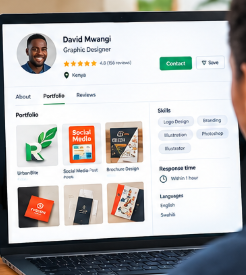
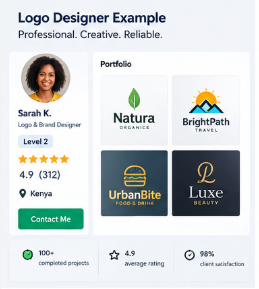
- Review portfolios. Most sellers display samples of past work directly on their profile, so you can judge style and quality before reaching out.
- Read customer reviews. Verified buyer reviews give you a sense of reliability, communication, and whether past clients got what they expected.
- Compare packages. Many freelancers offer tiered packages (basic, standard, premium) with different scopes — useful for matching your budget to your needs.
- Check delivery times. Estimated turnaround is usually listed upfront, which helps you plan around your own deadlines.
- Review revisions and requirements. Each listing typically states how many rounds of revisions are included and what information the freelancer needs from you to start — both of which affect how smoothly the project goes.
If you want to explore what’s available, you can start here: FIVERR
Whichever platform or method you use, the underlying goal is the same: gather enough information to compare freelancers on more than just price.
4. How to Evaluate a Freelancer
Once you have a shortlist, evaluation is where most of the real decision-making happens. A few data points matter far more than others:
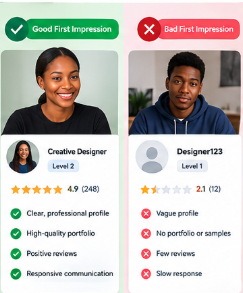
- Portfolio. Does their past work look like what you need, or just work in general? A designer with beautiful illustration work isn’t necessarily strong at clean, minimal branding.
- Reviews. Look for patterns, not just star ratings — repeated comments about missed deadlines or poor communication are more telling than a single low score.
- Experience. Years in the field matter less than relevant experience. Someone who’s done fifty logos for tech startups may be a better fit than someone with a decade of general design work.
- Communication. How quickly and clearly do they respond before you’ve even hired them? This is usually a preview of how the whole project will go.
- Understanding of the project. Do they ask clarifying questions, or do they just say “yes, I can do that” to everything? The former is a good sign.
- Delivery time. Realistic timelines matter more than fast ones — a freelancer who promises an unrealistically quick turnaround is a risk flag, not a bonus.
- Revisions. Know upfront how many rounds are included and what counts as a revision versus a new request.
- Pricing. Understand not just the number, but what it includes.
- Previous work with similar businesses. A freelancer who’s worked with businesses like yours will need less onboarding and fewer corrections.
A crucial point worth repeating: the cheapest freelancer is rarely the best value. Low prices often mean fewer revisions, slower communication, less experience, or corners cut on research and quality control. The goal isn’t to minimize cost — it’s to maximize the ratio of quality to cost, which is a different calculation entirely. A freelancer who charges more but delivers work you can use immediately, with no back-and-forth, is often the cheaper option once you account for your own time.
5. Understanding Freelance Pricing
Freelancers generally price their work using one of three models. Understanding the differences helps you choose the pricing structure that fits your project and helps you spot when a quote doesn’t match the type of work involved.
By the word
Common for writing and editing projects. You pay a rate per word (or per 100/1,000 words), which makes costs predictable for content-heavy work.
- Advantage: Easy to estimate total cost upfront, especially for long documents.
- Disadvantage: Doesn’t account well for research time, formatting, or complexity that isn’t reflected in word count.
By the hour
Common when the scope is hard to define in advance — ongoing design work, consulting, or projects likely to evolve.
- Advantage: Flexible and fair when requirements are genuinely uncertain at the start.
- Disadvantage: Total cost is less predictable, and it requires more trust (or time tracking) between both parties.
The more project-based pricing makes sense; the more open-ended the work, the more hourly pricing protects both sides.
By the project
Common when deliverables and scope are clearly defined upfront — a logo, a set number of blog posts, a landing page.
- Advantage: You know the total cost before work begins, which makes budgeting simple.
- Disadvantage: Scope creep (small extra requests) can create friction if boundaries aren’t set clearly at the start.
None of these models is universally “better” — the right one depends on how well-defined your project is. As a rule of thumb: the more clearly you can describe the deliverable
6. Example: Hiring a Graphic Designer or Logo Designer
Logo and brand identity work is one of the most common (and highest-stakes) freelance hires for a new business, so it’s worth walking through what to look for specifically.
When evaluating a graphic or logo designer, pay attention to:
- Portfolio. Look for range and consistency — can they adapt their style to different brands, or does every logo look similar regardless of the client?
- Design style. Does their aesthetic match what your brand needs (minimal, playful, corporate, bold)? A technically skilled designer whose style doesn’t fit your brand is still the wrong hire.
- Understanding of branding. A good logo designer asks about your audience, your values, and your competitors — not just “what colors do you like?” Logos that come from a real branding conversation tend to age better than ones chosen purely on visual preference.
- Number of concepts offered. Most packages include a set number of initial concepts (often 2–4). More isn’t always better, but one single take-it-or-leave-it option gives you no real choice.
- Revisions included. Confirm how many rounds of changes are covered before extra revisions cost more.
- Final file formats. You’ll typically need vector files (AI, EPS, SVG) for scalability, plus PNG/JPG versions for everyday use. Confirm this before the project starts — receiving only a low-resolution JPG is a common and frustrating surprise.
- Ownership of the finished work. Make sure the agreement is clear that you own full commercial rights to the final logo once paid in full. This is standard on most freelance platforms but worth double-checking, especially for custom illustration-heavy designs.
Confirming these details upfront—ideally in writing, before work begins—is what separates a smooth logo project from one full of back-and-forth surprises.
Final Thoughts
Hiring a freelancer isn’t a gamble if you approach it methodically. Know what kind of specialist you actually need, use a platform that lets you compare real portfolios and reviews side by side, evaluate candidates on more than price, and understand the pricing model you’re agreeing to before work starts. If you’re looking for freelancers across creative and digital services, Fiverr lets you browse available professionals and compare their portfolios, reviews, services, and pricing before deciding who fits your project.